
Balance sheet yellow flags

As we’ve learned in a previous lesson, the balance sheet is important because it tells investors how much the company has in assets (e.g., cash, property) and liabilities (how much money it owes to vendors, banks, and bondholders).
In that same lesson, we reviewed the balance sheet’s major sections and the information the different line items revealed.
Today, we will look at eight yellow flags you can quickly identify within minutes of reviewing a company’s balance sheet.
Balance Sheet Yellow Flags
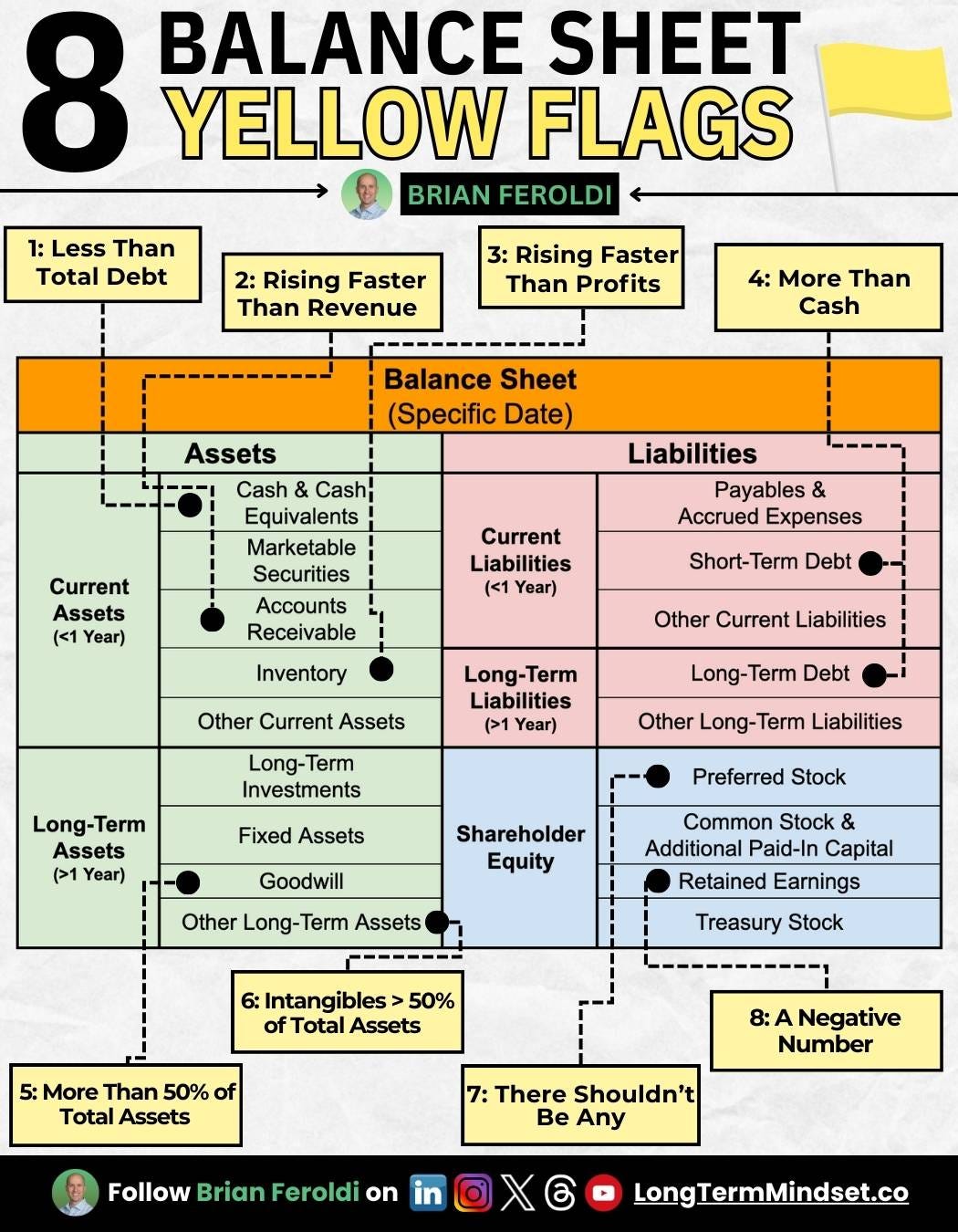
Yellow Flag #1 - Cash & cash equivalents less than total debt
Harold Geneen, a famous business leader, once said, “The only unforgivable sin in business is to run out of cash.” Cash gives companies flexibility. It gives them options. Debt takes that away. It makes them fragile.
Yellow Flag #2 - Accounts receivable rising faster than revenue
Accounts receivable are funds customers owe for products and services they have already received. If accounts receivable start rising faster than revenue, it could indicate that its customers are having difficulties paying their bills. This is especially something to watch when a company has high customer concentration or operates in a cyclical industry.
Yellow Flag #3 - Inventory rising faster than profits
Inventory refers to the value of products the company has manufactured and is ready to sell but has not yet sold. It can also include the value of subcomponents not yet built into a finished product. As inventory rises, profits should generally rise too.
For instance, if a retailer opens more stores, inventory and profits should rise. However, if inventory is rising without a commensurate increase in earnings, it could mean the company is struggling to sell the merchandise on its shelves.
Yellow Flag #4 - Short-Term + Long-Term Debt Is More Than Cash
As shareholders, we want to invest in antifragile companies with enough cash to meet their financial obligations for the foreseeable future.
Yellow Flag #5 - Goodwill is more than 50% of total assets
Goodwill is the premium that one company pays to acquire another company.
If goodwill exceeds 50%, a company may have purchased other companies to boost its top line. This practice could hide a company’s challenges in producing organic growth (e.g., through its existing products and services).
Yellow Flag #6 - Intangibles > 50% of total assets
Investors should want a company’s balance sheet loaded with liquid or usable assets, such as cash, factories, and property. Companies with primarily intangible assets can have assets, such as goodwill, that cannot be used to capture future returns.
Yellow Flag #7 - A company has preferred stock
Preferred stock is a class of stock with a higher claim to dividends and asset payouts than common stock shareholders. There are some benefits, but it is often more expensive than debt over the long term.
Yellow Flag #8 - Retained earnings are a negative number
Retained earnings are the cumulative profits companies have generated since their founding (minus losses, dividends, and share buybacks). When this number is negative, it could show that a company is unprofitable.
It’s important to note that these are yellow flags representing caution.
They are not necessarily signals to sell or avoid stocks that exhibit these flags.
When you’re driving your car, and the dashboard’s check engine light flashes on, do you immediately go to the dealership and trade your vehicle in? No, of course not!
You take it to a mechanic or, if you know how to work on cars, pop the hood up to look things over yourself.
In the same way, the balance sheet’s yellow flags represent caution, a signal that more investigation is required, but are not, in and of themselves, an immediate reason to sell a stock.
In fact, in some cases, shareholders were rewarded considerably for holding through these yellow flags.
For example, Home Depot has negative retained earnings. But once you investigate the matter further, you realize it’s only because the home improvement retail giant has been aggressively buying back stock and paying dividends for years.
Because both of these things reduce retained earnings, Home Depot’s retained earnings have gone negative.
There can also be good reasons for companies to hold less cash than debt, issue preferred stock, show rising inventories, or have many intangible assets.
Accounting is the language of business, but it’s a language of nuance and subtlety. The primary takeaway of any of these yellow flags spotted on a company’s balance sheet is that more investigation is required.
Wishing you investing success,
Brian