
8 Cash Flow Statement Yellow Flags

As we learned in a previous lesson, the cash flow statement is like your personal checking account. It aims to track cash deposits and withdrawals from the company’s bank accounts.
In that same lesson, we reviewed the importance of the cash flow statement’s three primary sections (operating, investing, and financing activities).
Today’s lesson will identify eight yellow flags you can spot within minutes of opening a company’s cash flow statement.
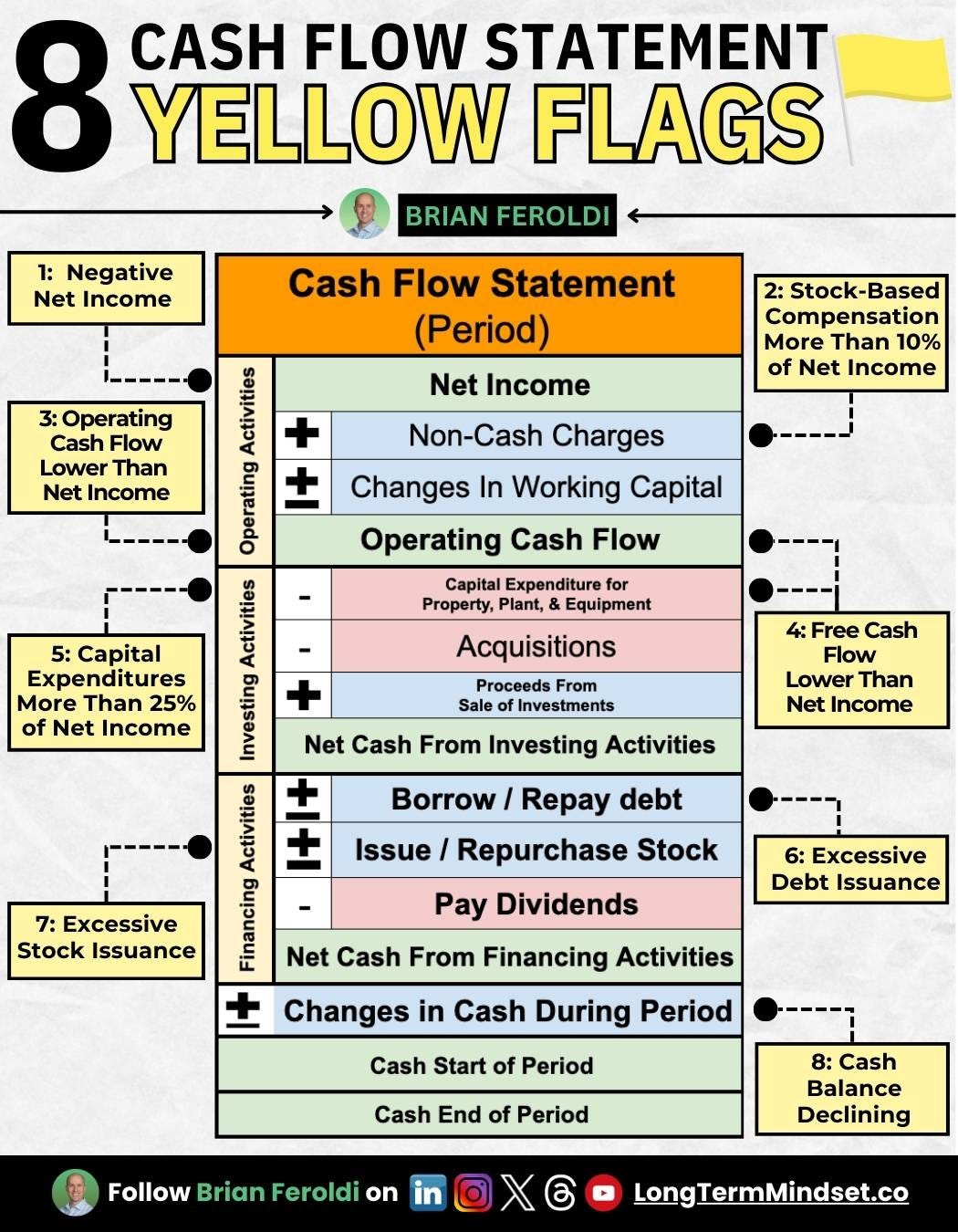
1 - Net Income Negative
Starting at the top of the cash flow statement, when net income is negative, it indicates the company is not generating a profit from its sales.
While a business can continue to operate by using the cash on its balance sheet, issuing more shares, or borrowing money, none of those are good long-term options.
2- Stock-Based Compensation More Than 10% of Net Income
Stock-based compensation is a way companies can reward employees without paying more in salary.
The benefits are that it aligns employees with the company’s goals.
It can be especially helpful for young, growing companies that might not yet generate much free cash flow.
The downside is that it dilutes the ownership stake of existing shareholders.
When stock-based compensation reaches 10% of net income, investors need to recognize they are being seriously diluted by management!
3 - Operating Cash Flow Lower Than Net Income
Operating cash flow is critically important for investors to understand.
The graphic above shows that operating cash flow is calculated by starting with net income and adding back non-cash charges like depreciation, amortization, and stock-based compensation.
Operating cash flow should always be larger than net income.
When this number is significantly lower than net income, it can signal troubling signs, such as unsold inventory.
4 - Free Cash Flow Lower Than Net Income
Free cash flow represents how much cash the business generates from its operations minus the cost of capital expenditures.
It’s a great sign when free cash flow exceeds net income; that means the company generates cash as it grows.
5 - Capital Expenditures More Than 25% of Net Income
Few great companies need to reinvest significant profits into the business to grow. It’s a great sign when capital expenditures are consistently less than 25% of net income.
Capital expenditures are a great way to fuel business growth, such as building new factories or upgrading stores.
However, when these charges are excessive, it could mean that the company is overspending.
6 - Debt Increasing
Great companies don’t need debt to fund themselves, especially in an environment of high interest rates.
Look for companies reducing their debt load, not increasing it.
7 - Stock Offering
Stock issuance isn’t a shareholder-friendly move. Like stock-based compensation, it dilutes existing shareholders.
Great companies reward shareholders by returning capital via dividends and buybacks, not punish them by issuing more shares.
8 - Cash Balance Declining
When the change in cash balance is negative over a period, it could signal that management is not spending money wisely or that the business is struggling.
It’s a wonderful sign when companies pay for capital expenditures, reduce debt, repurchase shares, pay dividends, and still see the cash balance increase at the end of the quarter.
As always, it is essential to remember these are yellow flags, not immediate reasons to sell a stock.
Think of each yellow flag as a dashboard indicator on your car. When a light goes off, you know something under the hood requires more attention, not that the car needs to be immediately replaced.
Netflix’s free cash flow was consistently negative for years, even as it showed positive net income.
Even after the streaming service finally went free cash flow positive, it significantly lagged its net income.
Yet the stock richly rewarded patient shareholders willing to hold through volatility.
Wishing you investing success,
Brian Feroldi
Crystal clear, as usual. Thank you!
Nice. I also tried to write abou FCF: (would love your thoughts) https://rudajev.substack.com/p/episode-6-free-cash-flow-the-metric?r=1uglxj