
6 Business Yellow Flags

In our previous lessons, we’ve looked at the yellow flags commonly found on companies’ balance sheets, income statements, and cash flow statements.
Here, we must pause and acknowledge that not all yellow flags are found within the confines of a company’s financials. Some of the most problematic yellow flags occur outside these bounds.
Today’s lesson will identify the five most common yellow flags so investors can look for them when reviewing their portfolios.
Business Yellow Flags
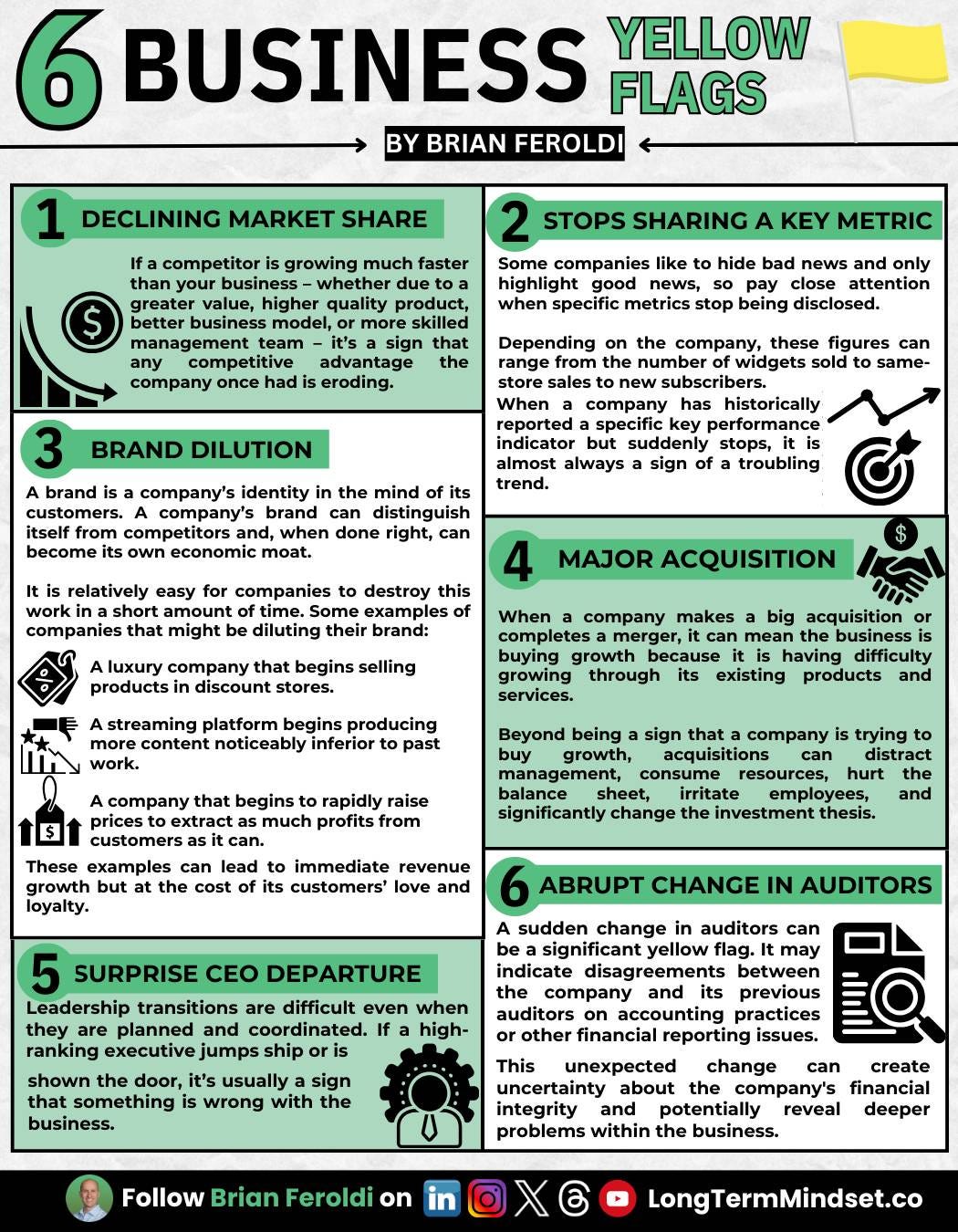
1 - Declining market share
If a competitor is growing much faster than your business, it’s a sign that any competitive advantage the company once had is eroding. Reasons could include competitors having a greater value, higher quality product, better business model, or more skilled management team.
2 - Stops sharing a key metric
Some management teams like to hide bad news and only highlight good news, so pay close attention when specific metrics stop being disclosed.
Depending on the company, these figures can range from the number of widgets sold to same-store sales to new subscribers.
When a company has historically reported a specific key performance indicator but suddenly stops, it is almost always a sign of a troubling trend.
3 - Brand dilution
A brand is a company’s identity in the mind of its customers. A company’s brand can help distinguish itself from competitors and, when done right, can become its economic moat.
While this takes time and effort, it is relatively easy for companies to destroy this work in a short amount of time.
Here are several examples of actions that might dilute brand power:
A luxury company that begins selling products in discount stores.
A streaming platform that begins producing more content noticeably inferior to past work.
A company that begins to rapidly raise prices to extract as much profits from customers as it can.
These examples can lead to immediate revenue growth but at the cost of its customers’ love and loyalty. That’s not a formula for long-term success.
4 - Major acquisition
When a company makes a big acquisition or completes a merger, we sometimes say the business is “buying growth.”
This refers to the situation where a company is having difficulty growing through its existing products and services, so it turns to acquisitions to artificially boost the top line.
Additionally, acquisitions can distract management, consume resources, hurt the balance sheet, irritate employees, and significantly change the investment thesis.
5 - Surprise key executive departure
Leadership transitions are difficult even when they are planned and coordinated. If a high-ranking executive jumps ship or is shown the door, it could be a sign that something is wrong with the business.
6 - Abrupt change in auditors
A sudden change in auditors can be a significant yellow flag. It may indicate disagreements between the company and its previous auditors on accounting practices or other financial reporting issues.
This unexpected change can create uncertainty about the company’s financial integrity and potentially reveal deeper problems within the business.
Remember, we consider these situations to be yellow flags. Similar to a caution light, they represent when investors should take a minute to slow down and look more deeply at the company.
It doesn’t always mean significant trouble. There are plenty of examples of companies displaying one or more of these yellow flags that continued to outperform.
One example is when Apple, in 2018, stopped sharing its iPhone unit sales.
By halting the disclosure of this number, investors were robbed of knowing how many of its flagship products Apple was selling and could no longer calculate the iPhone’s average selling price.
Apple’s management believed the figure no longer represented the strength of its growing ecosystem of products and services.
Apple’s stock price tripled over the next five years, beating the S&P 500’s returns significantly.
Accounting is the language of business, but it is often expressed in shades of gray, not black and white.
So, is immediate action ever required? Are there any red flags investors should be aware of?
Yes! In our mind, there is only one: Accounting fraud.
When a company fabricates financial records or otherwise falsifies the success of its company, we feel that it would be in investors’ best interests to sell that stock immediately.
Wishing you investing success!
Brian Feroldi